
Slope Stability and Mitigation Measures Online Course
Learn slope stability analysis online with practical training, case studies, and mitigation techniques for geotechnical engineering projects.
199.00$

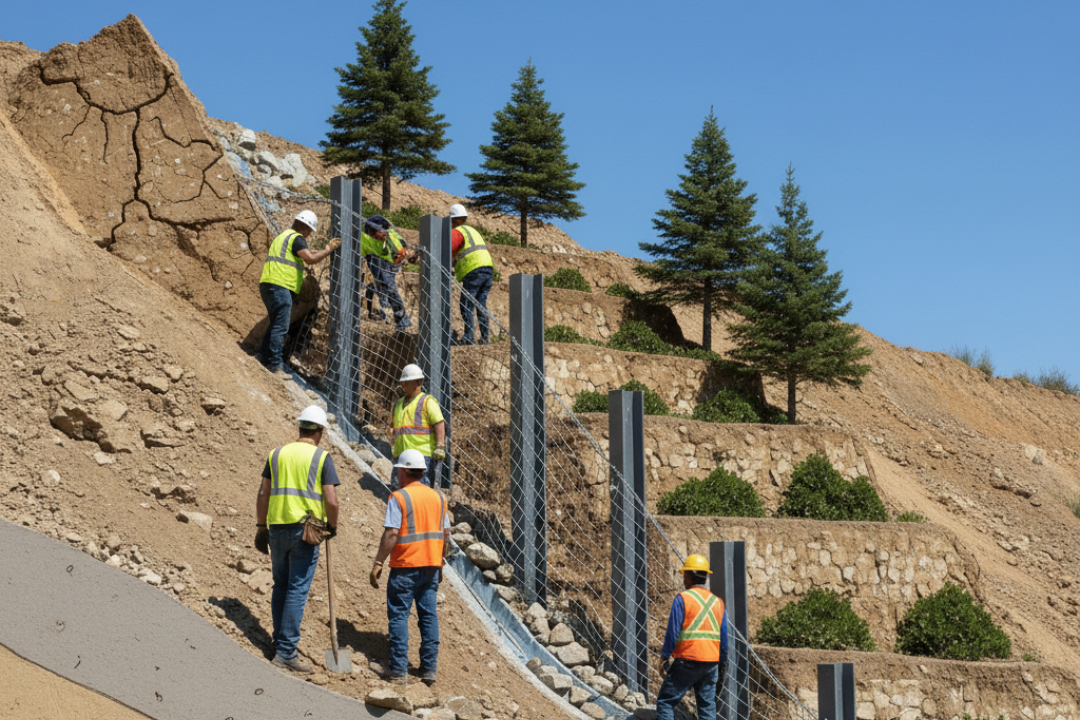
Slope Stability Training Online Course
Get a chance to discover in-depth knowledge of slope stability, failure mechanisms, and mitigation strategies. This Slope Stability Course equips professionals with analytical and practical skills for safer geotechnical design.
Online Program
Branch: PIGSO LEARNING
Schedule of Classes
Everything You Need to Know
Course Overview & Batch Schedule
Our Slope Stability Training Course Online is designed to give you practical, industry-relevant skills in geotechnical slope analysis, limit equilibrium methods, and stability assessment for natural slopes, embankments & excavations. Live batches, recorded sessions, and expert support ensure you can learn at your own pace without missing any class.
Total Duration
20+ Hours Live
Format
Live Online (Zoom)
Language
English
Certificate
Verified Certificate
Batch #001
UpcomingWhere Slope Stability Skills Are Used
Slope stability assessment is a core skill in civil, mining and environmental engineering, protecting roads, dams, excavations and communities. Here's where your skills will be put to work.
01
🛣️ Highways, Railways & Hillside Infrastructure
Road and rail corridors and hillside developments need stability checks for cut slopes, fill slopes and landslide-prone terrain, including how rainfall and groundwater changes reduce the factor of safety over time.
02
⛏️ Open-Pit Mining & Tailings
Open-pit walls, waste rock dumps and tailings dams are analysed for overall and bench-scale stability, with seismic loading, pore pressure and stabilisation measures built into the design and monitoring plan.
03
🏞️ Dams, Levees & Excavations
Earth dams, levees, river banks and deep excavations are checked for rapid drawdown, seepage and construction-stage stability, with retaining walls, soil nails and anchors designed to reach the required safety factor.
Slope Stability Modules You'll Master
Slope stability analysis is how engineers decide whether a natural slope, embankment, cut or dam will stand safely. This online course covers the essential topics used on highway, mining, dam and hillside projects: soil and rock strength, limit equilibrium, groundwater effects, seismic loading, finite element strength reduction, and stabilisation design.
Slope Stability Fundamentals & Site Investigation
Understand how and why slopes fail, with failure types, factor of safety concepts, site investigation, soil and rock classification, and the geological and groundwater data needed before any analysis begins.
Module 1Shear Strength & Parameter Selection
Choose reliable strength parameters using Mohr-Coulomb, effective and total stress, drained and undrained behaviour, residual strength and the Hoek-Brown criterion for rock, backed by lab and field test data.
Modules 2–3Limit Equilibrium Methods & Slip Surfaces
Apply Fellenius, Bishop, Janbu, Spencer and Morgenstern-Price methods, search circular and non-circular slip surfaces, and run sensitivity and probabilistic checks on the factor of safety.
Modules 4–5Groundwater, Rainfall & Rapid Drawdown
Model phreatic surfaces, piezometric lines and seepage-based pore pressures, then evaluate how rainfall infiltration and rapid drawdown change slope stability over time.
Module 6Seismic Analysis & Strength Reduction
Assess earthquake loading with pseudo-static and Newmark displacement methods, and use finite element shear strength reduction to find the critical failure mechanism and compare it with limit equilibrium.
Modules 7–8Slope Stabilisation Design & Reporting
Design soil nails, anchors, retaining walls, geosynthetic reinforcement, drainage and buttresses to reach target safety factors, then present results in a clear stability report.
Module 9Core Skills You'll Master
-
✔Principles of Slope Stability & Failure MechanismsUnderstand shear strength, failure modes (planar, circular, wedge, toppling), and the key factors governing slope instability in soil and rock.
-
✔Limit Equilibrium Methods (LEM)Apply Bishop, Morgenstern-Price, Spencer, and Janbu methods to calculate factors of safety for circular and non-circular slip surfaces.
-
✔Seepage & Pore Water Pressure EffectsAnalyse the influence of groundwater, phreatic surfaces, and pore water pressure on slope stability under static and transient conditions.
-
✔Slope Stability Software & ModellingBuild and analyse slope models using industry-standard tools such as SLOPE/W, RS2, and PLAXIS to simulate real geotechnical conditions.
-
✔Slope Stabilisation & Remediation TechniquesEvaluate and design stabilisation measures including retaining walls, soil nailing, drainage systems, and geotextile reinforcement.
-
✔Industry ProjectsApply slope stability analysis to real-world case studies including natural slopes, embankments, cuttings, and open-pit mining scenarios.
Learn by Doing in Slope Stability Analysis
Everything You Need to Master Slope Stability
Interactive live classes working through slope models with real-time Q&A.
Revisit every recording and worked example anytime for 12 months.
Hands-on projects on highway cuts, embankments, dams and open-pit slopes.
Get personalized support from practising geotechnical engineers.
Practice factor of safety, groundwater and seismic problems module by module.
Industry-recognized slope stability certification.
Learn from real landslide, embankment and mine slope project data.
Attend from anywhere with flexible timing.
Enroll in Slope Stability Online Training
Go beyond textbook calculations with practical slope stability workflows: limit equilibrium, groundwater and seismic analysis, and stabilisation design for slopes, embankments and excavations.
How Our Slope Stability Training Compares
Master slope stability analysis through hands-on projects, expert mentoring, and industry-focused geotechnical workflows.
| Feature | Pigso Learning | Generic Online | University |
|---|---|---|---|
| Full Slope Stability Hands-On Training | ✔ Full Workflow | ✖ Theory Only | ✖ Mostly Hand Calcs |
| Live Instructor Sessions | ✔ Weekly Q&A | ✖ Recorded Only | ✔ Sometimes |
| Real Industry Case Studies | ✔ Highways / Dams / Mining | ✖ Generic | ✖ Academic Only |
| Capstone Project | ✔ Reviewed | ✖ Not Included | ✔ Sometimes |
| Mentor Support | ✔ 1-on-1 | ✖ Forums Only | ✖ Limited |
| Job Ready | ✔ 6–8 Weeks | ✖ No Structure | ✖ Years |
The Comparison Speaks for Itself
Full hands-on slope stability training, live mentorship, and a job-ready skillset, all in 6–8 weeks.
Course Overview
The slope stability and mitigation measures course provides a complete introduction to failure mechanisms, safety factors, and stabilisation methods. You will study the causes of slope failures, learn to evaluate stability using analytical and computational approaches, and apply preventive or corrective measures such as retaining systems, reinforcement, and drainage. Case studies from real projects are included to strengthen practical understanding.
Course Instructor

Info PIGSO
14 Courses • 56 Students
Course Curriculum
1 Subject
Slope Stability and Mitigation Measures Online Course
Contact Our Experts
Have any doubts? Get your questions cleared about the Slope Stability Course? Connect with our geotechnical training experts for personalised guidance on course details, enrollment, and certification options.
Related Courses
Frequently Asked Questions
Who should enroll in this Slope Stability Course?
This course is ideal for civil, geotechnical, and mining engineers, as well as geology professionals involved in slope design, landslide analysis, or stabilization projects.
Does prior knowledge required to enroll?
A basic understanding of soil mechanics or geotechnical engineering is recommended, though the course also supports beginners seeking foundational slope analysis knowledge.
What practical skills will I gain from this course?
You will learn to perform slope stability assessments, design retaining structures, apply mitigation measures, and interpret analytical results with confidence.
Is there a certification upon completion?
Yes, participants receive a verified completion certificate recognizing their knowledge and practical skills in slope stability and landslide mitigation.
How is this course delivered?
The training is delivered online with interactive modules, practical assignments, and instructor-led sessions to ensure applied learning and engagement.
By clicking on Continue, I accept the Terms & Conditions,
Privacy Policy